

- Наши решения
- MDDC
- Карьера
- Ресурсный центр
 Back
Back
March 8, 2022
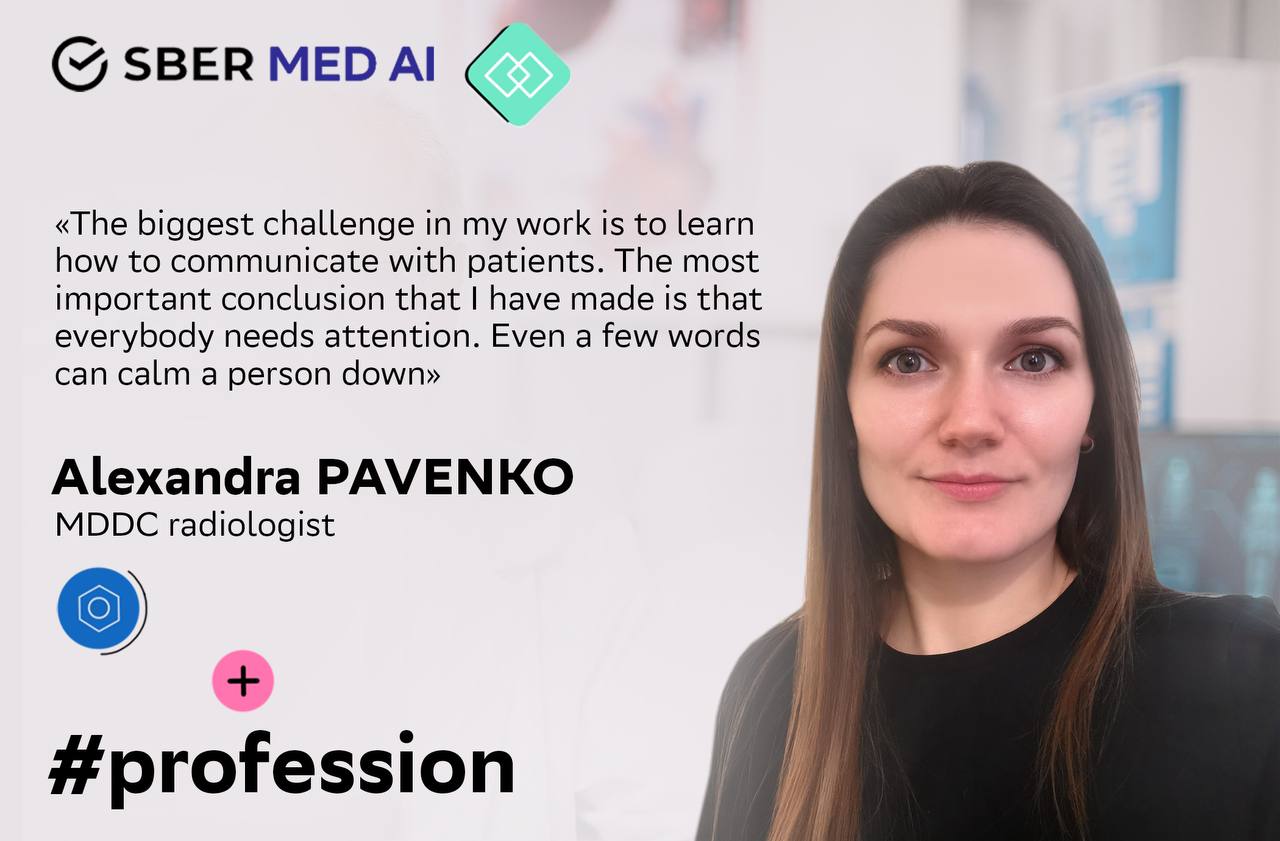
We decided to have beautiful female doctors tell you about the radiologist profession. Meet Alexandra Pavenko, MDDC radiologist
You are not born to be a doctor, but you can become one. However, I had practically no other choice, in my family, we all are doctors: my mother is an ENT doctor, my father is a surgeon, a chief of department, my grandfather was a chief physician, and my grandmother was a chief pharmacist. That said, after three years at medical institute, I entered the Chemistry Department for parallel studying, and I nearly left for it, but ultimately chose X-ray diagnostics.
I was lucky with my first employer: it was the Central Clinic Diagnostic Center of Omsk and the Omsk Region. We had many complicated and interesting problems to resolve. For example, we were tasked to either confirm or deny heart malformation in newborns (about 14 days of age) from the City Clinical Perinatal Center, in order to operate on the child as early as possible. Such an examination is never easy, in order to perform it, the infant needs to be anesthetized, and, of course, the accurate diagnosis is essential.
The biggest challenge in my work is to learn how to correctly communicate with patients. A lot of factors make their impact: from the person’s emotions and nervousness to a possible “diagnosis” one could make based on articles from the internet.
However, the key conclusion I made is that everyone needs attention. Even a few words can calm the person down.
Together with my colleagues from other departments (surgeons, proctologists) we are continuously introducing new methods of examination. My anti-burnout method is to learn continuously, note the results, be happy about even small victories, and see the use of what you are doing.
I am collaborating with the MDDC service and I understand that the future of healthcare is in the effective interaction between doctors and artificial intelligence. In critical situations (such as the pandemic), admission departments, which often have excessive workload even during regular operations, are on the front line. Using AI for screening helps us to reduce the examination time and facilitates the doctor’s work. Services draw the doctor’s attention, primarily, to the most complicated cases, therefore, a radiologist can quickly issue a medical conclusion for patients who need urgent help.


